Does knee pain make a bottle look like an answer?
Can a label tell you a safe KLOW peptide dosage?
Knee pain can make another treatment sound worth a try. But a bottle's weight can't tell you a safe amount. Researchers tested separate ingredients. Nobody found how much of the mixture people can safely take.
What does the lack of a dose study mean for you?
A painful knee deserves a tested treatment. KLOW peptide dosage lacks a human study. Nobody knows an amount that helps and has been checked for harm. Your bottle's label can't supply that missing test.
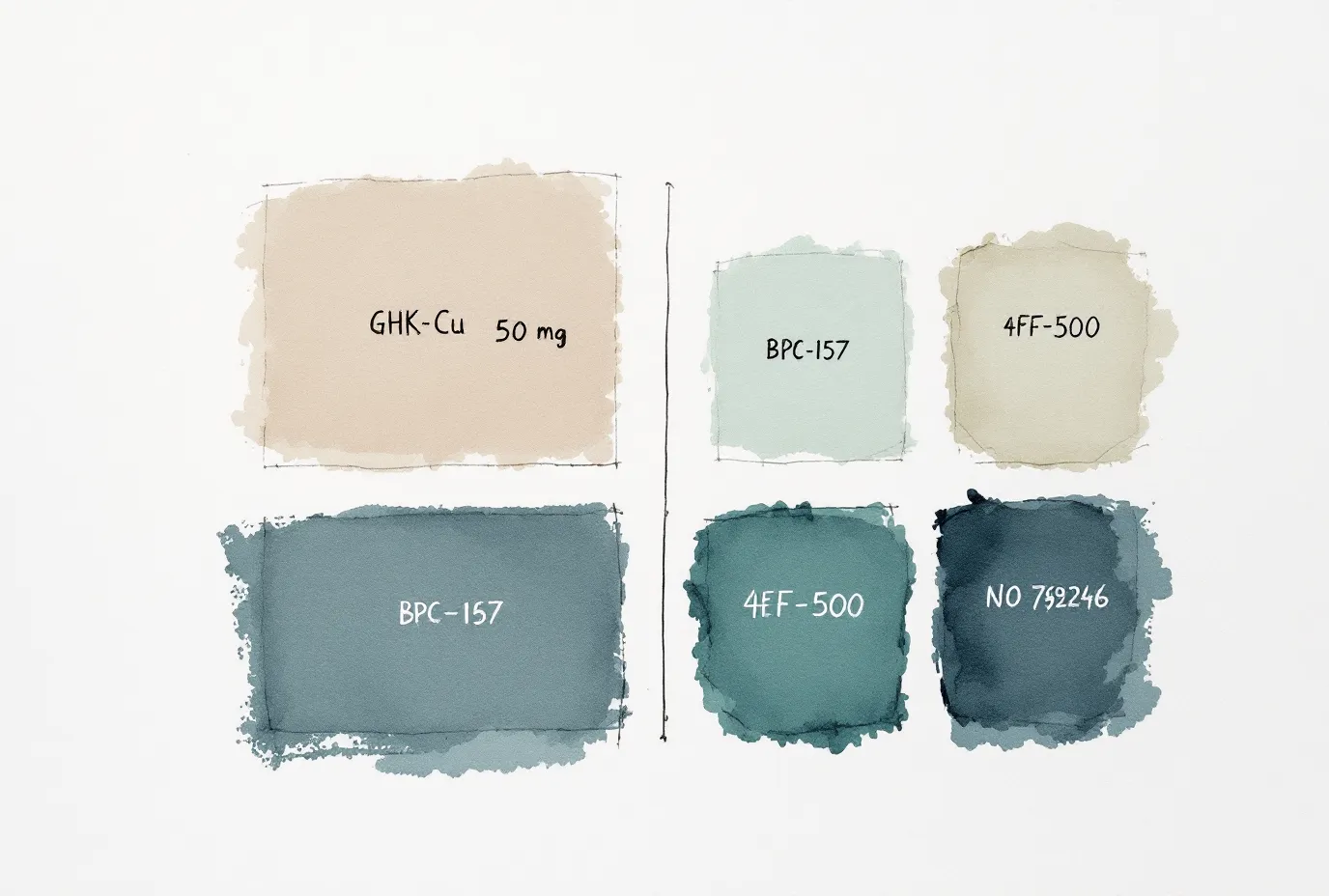
A usual bottle's powder weighs 80 mg in total: GHK-Cu 50 mg, BPC-157 10 mg, TB-500 10 mg and KPV 10 mg. Milligrams are units of weight. These figures count what's in the bottle. They don't establish what you can safely take.
Some ingredients stay in the body longer than others. In animals, half the measured BPC-157 was gone in less than about half an hour. KPV disappeared sooner, and so did GHK-Cu. The amounts left later weren't the same balance as at the start.
Nobody knows what that changing mixture would do for you.
Each separate test chose its animals and how the ingredient was given. Adding their amounts can't establish your dose. The research below describes tests, not instructions for taking the mixture.
What amounts did the animal and cell tests actually use?
These tests weren't meant to find your dose. Rats with stomach ulcers received BPC-157 at 400 and 800 nanograms per kilogram of body weight [4]. Rats with cut tendons received one of three daily amounts: 10 micrograms, 10 nanograms or 10 picograms per rat [5]. Those weights get smaller in that order, and you can't directly compare them with the ulcer-test amounts because one test used each rat's weight and the other used an amount per rat.
Thymosin beta-4 helped skin cells move at 10 picograms, a tiny weight [6]. Researchers treated wounds by putting the protein on skin or injecting inside the abdomen. KPV worked in dishes at 10 nanomoles per liter, the study's measurement of how little KPV was dissolved in liquid. The drinking water for mice contained 100 micromoles per liter, another measure of dissolved KPV [2]. GHK-Cu was tested in small amounts in dishes and on human skin [7].
None of these separate amounts establishes a safe dose of the combined bottle for you [1].
Does the 80 mg total prove GHK-Cu matters most?
No. The usual 80 mg contents are GHK-Cu 50 mg, BPC-157 10 mg, TB-500 10 mg and KPV 10 mg. The remaining 30 mg is divided equally among the last three.
You still have four ingredients after the powder dissolves [1]. There's no FDA-approved KLOW product or published medicine standard for checking the blend's contents.
The largest weight isn't proof of the greatest help.
What does freeze-dried mean when you see the bottle?
The bottle holds powder. Freeze-drying means freezing the liquid, then removing its water. Labs use water with an added preservative to keep germs from growing. The liquid is usually refrigerated. That describes lab work, not a way for you to prepare treatment.
The copper in GHK-Cu might alter other ingredients [12]. Researchers haven't fully checked those possible changes in the mixture.
The same copper makes the liquid blue or teal [7]. That color by itself doesn't mean the contents are faulty.
You can't judge safety from color either.
Will all four ingredients stay in your body equally long?
No. Animal blood tests found half the measured BPC-157 had gone in less than about 30 minutes. The ingredient quickly broke into smaller pieces [9]. KPV was removed sooner, as was GHK-Cu. TB-500 isn't the full thymosin beta-4 protein; the shorter piece can't be assumed to last as long.
An ingredient leaving quickly could be gone while another is still present. Timing based on the longer-lasting ingredient wouldn't keep the faster one present. You can't predict the changing mixture's effects from the separate tests [1].
You still don't know a safe amount or when to take the mixture.
Were the ingredients swallowed, rubbed on skin or injected?
Shots beneath the skin were the most usual method studied. Researchers also put GHK-Cu on skin [7]. KPV and BPC-157 were swallowed or given directly to the gut [2][4]. Some tests injected BPC-157 into joints.
You can't treat those methods as tested instructions for using KLOW.
Can you turn animal amounts into daily KLOW peptide use?
Adding animal-study amounts doesn't produce a tested dose for you. A usual 80 mg bottle lists GHK-Cu 50 mg, BPC-157 10 mg, TB-500 10 mg and KPV 10 mg [1]. Each test chose its animals and how the separate ingredient was given.
Your safe daily amount needs its own human study.
Does quick removal tell you when another amount is safe?
It doesn't. Researchers haven't established safe timing in people. In animals, half the measured BPC-157 was removed from blood in less than about 30 minutes [9][1]. KPV was removed sooner, along with GHK-Cu. The amounts compared with each other changed as ingredients left.
You don't get a safe human schedule from those animal measurements.
Can copper change other ingredients while the bottle is stored?
It might, but the mixture hasn't been fully checked. Labs use water with an added preservative to dissolve freeze-dried powder. The liquid is usually kept refrigerated.
GHK-Cu's copper could change other ingredients while stored together [12]. Ingredients can still be damaged without joining into a new substance.
This isn't a preparation guide for your use.
Does KLOW peptide dosage on a label establish safety?
Nobody has tested a dose for people. A usual bottle totals 80 mg: GHK-Cu 50 mg, BPC-157 10 mg, TB-500 10 mg and KPV 10 mg [1]. Labs use water with an added preservative to dissolve the powder.
Your label describes contents. The weights can't establish a safe dose.
Why are KLOW peptide dosage and timing both uncertain?
Neither has been tested in people. BPC-157 stays present longer than KPV or GHK-Cu. TB-500 is only part of the longer thymosin beta-4 protein [9][1]. You can't assume the short part lasts as long. The mixture changes as its ingredients leave.
Those differences don't establish your dose or schedule.
Would adding separate study amounts give a daily KLOW peptide dose?
No. The usual bottle contains 80 mg across four ingredients [1]. Human tests haven't established a daily amount. Adding amounts tested separately doesn't show how much of the mixture is safe.
Your label gives the weight of the contents. A human dose needs testing with every ingredient combined.