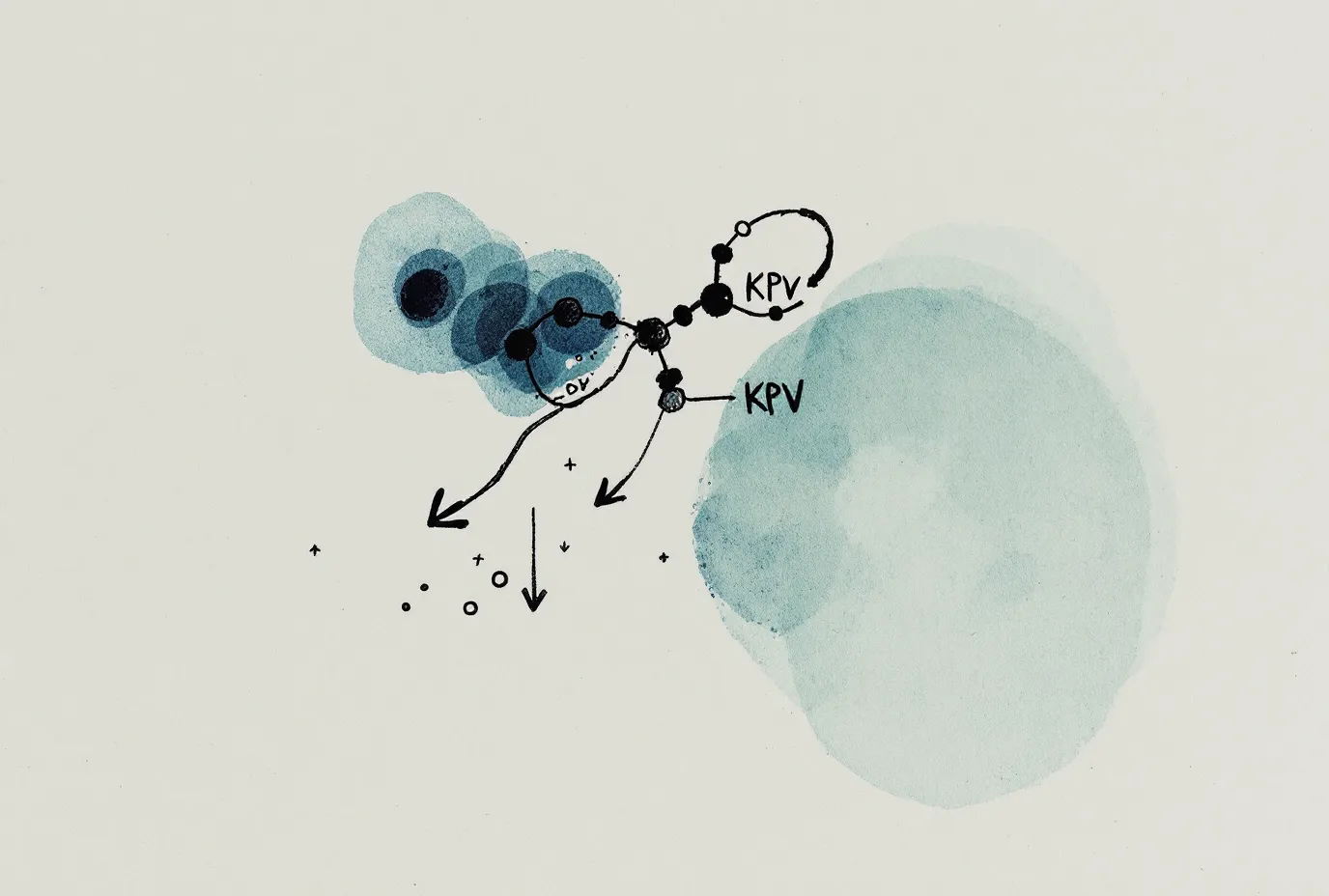
the four arms, and where they stop

KLOW Peptide Benefits and Reported Effects in the Research Literature

What each of the four peptides has shown — alone. What the research-use community reports — anecdotally. What the cited safety record flags. No blend study sits behind any of it.

The short version

These are the KLOW peptide benefits people look for, and the honest state of the evidence behind them. KLOW is four peptides in one vial. Each was studied on its own, mostly in cells and rats. So the "benefits" you read about are really four separate findings, lined up.

KPV calmed inflammation in lab and animal studies. GHK-Cu helped skin make collagen. BPC-157 sped tendon and gut healing in rats. TB-500 (a fragment of a wound-healing protein) helped wounds close faster.

No study has ever tested the four-peptide blend together. So nothing below is proven for KLOW — it is single-peptide research plus what users report. People in research-use circles describe faster recovery from nagging injuries, less ache, sometimes smoother skin. The downsides they mention are mostly minor, like injection-site redness. Both the upsides and the cautions are laid out plainly here.

What people report

These are effects reported by the research-use community — anecdotal, not clinical evidence, and never verified by a controlled trial. Reports come without a known dose, source, or product purity. Read them as field notes, not findings.

Benefits people describe (most common first):

  • Faster recovery from a nagging tendon, ligament or joint issuefrequently reported. The dominant theme: a stubborn shoulder, knee or Achilles problem easing over roughly three to four weeks.
  • Less joint and muscle pain / general achinessfrequently reported. Often the first thing noticed, before any structural change.
  • A broader "less inflamed" feelingfrequently reported. Lower background achiness and better gut comfort, often credited to the KPV arm, with the stack described as feeling more anti-inflammatory than the KPV-free GLOW blend. That comparison is a subjective impression, not a study.
  • Smoother, more hydrated skin with finer poresoccasionally reported. Usually credited to the mass-dominant GHK-Cu component; a gradual change, not an overnight one.
  • Better gut comfort or digestionoccasionally reported. A recurring "pleasant surprise," loosely tied to the KPV and BPC-157 gut research.
  • Better sleep or more vivid dreamsoccasionally reported. Strongest when stacked with other peptides; vivid dreams come up as a neutral side note.

Adverse effects people describe:

  • Injection-site redness, swelling or itchingfrequently reported. The single most-cited downside; usually minor and short-lived.
  • Initial fatigue or low energy in the first few daysoccasionally reported. A transient stretch that settles.
  • Mild headache or light-headednessoccasionally reported. Generally brief.
  • Flushing or a warm sensation after useoccasionally reported. Mentioned by a minority, shortly after administration.
  • Transient nausea or mild stomach upsetoccasionally reported. Despite the blend more often being credited with gut benefits.
  • No noticeable effect at alloccasionally reported. A counter-theme; discussion usually turns to unverified product quality as the suspected reason. With no regulated product, actual purity and content are unknowable.

Safety & cautions

These cautions are cited and component-level. Most are mechanistic — reasoned from how a peptide works, not from a clinical finding. Where that is the case, it is said plainly.

Athletes and anyone subject to anti-doping testing should treat KLOW as off-limits. TB-500 is the synthetic fragment of thymosin beta-4, and thymosin beta-4 is named on the WADA Prohibited List (S2, peptide hormones and growth factors), banned at all times, in and out of competition. Because TB-500 is one of the four components, the blend implicates anti-doping rules regardless of intent. This is a regulatory fact, not an extrapolation [10][11].

People with an active or recent cancer should be especially cautious. Three of the four components — BPC-157, TB-500/thymosin beta-4, and GHK-Cu — promote new blood-vessel growth; BPC-157 does so through the VEGFR2-Akt-eNOS pathway [3]. Solid tumors depend on new blood vessels to grow, so accelerating that growth is a theoretical concern flagged in the literature [6]. No human study has tested this either way, for any component or the blend. The caution is mechanistic, not a demonstrated risk.

Treat the four-peptide combination as untested. Every component was studied alone, mostly in cells and rodents. The KPV + GHK-Cu + BPC-157 + TB-500 combination has never been tested in a controlled study against monotherapy, a subset, or placebo. A pharmacokinetic mismatch compounds this: BPC-157 has a very short elimination half-life — under about 30 minutes in the formal study — and the tripeptides clear even faster, so a single dose cannot hold all four at matched exposures [9][11]. Every synergy claim is mechanistic extrapolation.

People with copper-handling disorders (such as Wilson's disease) should be cautious about the copper load. GHK-Cu is the mass-dominant component — about 50 of 80 mg — and each molecule carries a chelated copper(II) ion, so the blend delivers more copper than a typical peptide stack [7]. For anyone whose body cannot regulate copper normally, repeated copper delivery is a theoretical concern. No clinical study has examined copper accumulation from GHK-Cu in such individuals; the caution follows from the chemistry and GHK-Cu's dominant share [12].

People with autoimmune disease or an active infection should weigh the immune-modulating arm carefully. KPV is anti-inflammatory: it suppresses NF-kB-driven inflammatory transcription and is taken up preferentially into immune and epithelial cells [2]. Dampening inflammatory signaling is a theoretical consideration during an active infection — where inflammation is part of the defense — and an unpredictable variable in autoimmune disease [13]. No human study has tested KPV, or the blend, in either setting. The caution is mechanistic.

Why four peptides are combined

The KLOW stack pairs four peptides whose individual mechanisms sit at largely non-overlapping nodes of one tissue-repair network. KPV suppresses inflammatory transcription [2]. GHK-Cu drives matrix synthesis and supplies copper for collagen crosslinking [7]. BPC-157 drives the angiogenic pathway and connective-tissue repair [5][3]. TB-500, via the actin-binding motif of thymosin beta-4, aids cell migration and re-epithelialization [6].

The combination rationale is that these four arms address cytokine suppression, matrix remodeling, vascular supply and cytoskeletal mobility as complementary steps of one cascade. Rationale, not result: no controlled study has compared the blend against any single peptide or any subset [1].

Reported and theoretical concerns

A plain map of the KLOW side effects picture. The cited concerns are component-level and mostly theoretical: the WADA-prohibited status of TB-500 [10], a pro-angiogenesis cancer caution that no study has tested [6], the GHK-Cu copper load for copper-handling disorders [12], the immune modulation by KPV [2], and the untested-combination problem itself [1].

The community-reported effects are separate and anecdotal: most often minor injection-site redness, and occasionally mild headache, fatigue, flushing or transient nausea. None of these is a measured clinical outcome for the blend. With no regulated product behind any vial, source and purity stay unknown.

Can KLOW peptides help with gut and skin at the same time?

The components target different tissues. KPV and BPC-157 have gut-mucosa research — PepT1-mediated colitis benefit and gastric-ulcer cytoprotection in animals [2][4]. GHK-Cu has skin matrix-synthesis data [7]. But no blend study has tested both effects together, so any "gut and skin at once" claim is mechanistic extrapolation from the separate single-component literature, not proven for KLOW.

What does adding KPV to a repair stack do?

KPV is the anti-inflammatory arm. Nanomolar KPV inhibits NF-kB and MAP-kinase inflammatory signaling and lowers pro-inflammatory cytokines, and it is carried into inflamed gut epithelium via the PepT1 di/tripeptide transporter [2]. It adds cytokine suppression that the GHK-Cu, BPC-157 and TB-500 arms do not directly provide — the structural difference between this stack and the KPV-free GLOW blend.

How does KPV reduce inflammation?

KPV, the C-terminal tripeptide of alpha-MSH, suppresses NF-kB nuclear import and MAPK signaling in epithelial and immune cells, reducing TNF-alpha, IL-6 and IL-1beta [2]. In murine colitis it lowered myeloperoxidase and inflammatory infiltrate, an effect retained in MC1R-deficient mice — so it is MC1R-independent, likely acting through inhibition of IL-1beta function rather than a melanocortin receptor [14][13].

Does KLOW peptide work?

The four-peptide blend itself has never been tested in a controlled study, so there is no direct efficacy evidence for "KLOW." The case rests entirely on single-component research — tendon and gut repair from BPC-157 [5][4], wound closure from thymosin beta-4 [6], matrix synthesis from GHK-Cu [7], anti-inflammation from KPV [2] — extrapolated to the combination. Extrapolation is not proof.

How long does it take for KLOW peptide to work?

There is no blend timeline from any controlled study. Research-use community write-ups — anecdotal, not clinical evidence, and never with a verified dose — often describe a stubborn tendon, knee or shoulder issue easing over roughly three to four weeks, with pain relief sometimes appearing before any structural change. Treat that as a field note, not a result.

How long does it take to see results from KLOW peptide?

No measured timeline exists for the blend. In rodent single-component studies, thymosin beta-4 raised re-epithelialization by 42% at 4 days and up to 61% at 7 days [6], and BPC-157 accelerated tendon and ulcer healing over the study period [5][4]. These are animal single-component outcomes, not a human KLOW timeline.

What are the side effects of the KLOW peptide?

No controlled blend safety study exists. The cited cautions are component-level and mostly mechanistic: WADA-prohibited TB-500 [10], a pro-angiogenesis cancer caution [6], the GHK-Cu copper load [12], and immune modulation by KPV [2]. Research-use community reports — anecdotal — most often mention minor injection-site redness, and occasionally mild headache, fatigue or transient nausea.

What are the benefits of the KLOW peptide blend?

Described benefits trace to the separate components: anti-inflammatory signaling from KPV [2], collagen and matrix and antioxidant gene programs from GHK-Cu [7][8], tendon and gut repair plus angiogenesis from BPC-157 [5][3], and wound re-epithelialization from thymosin beta-4 [6]. These are single-component findings. No benefit has been demonstrated for the four-peptide blend itself [1].